Managed IT vs. a Fractional IT Consultant: Which Fits Your Small Business?
Managed IT and fractional consulting solve different problems. Picking the wrong one for your stage is a common — and expensive — mistake.
Managed IT vs. a Fractional IT Consultant: Which Fits Your Small Business?
Once a small business outgrows "call someone when something breaks," there are usually two paths forward: hire a managed service provider (MSP) to handle IT as an outsourced department, or bring on a fractional IT consultant to guide strategy and decisions. They solve different problems, and picking the wrong one for your stage is a common, and expensive, mistake.
What managed IT actually is
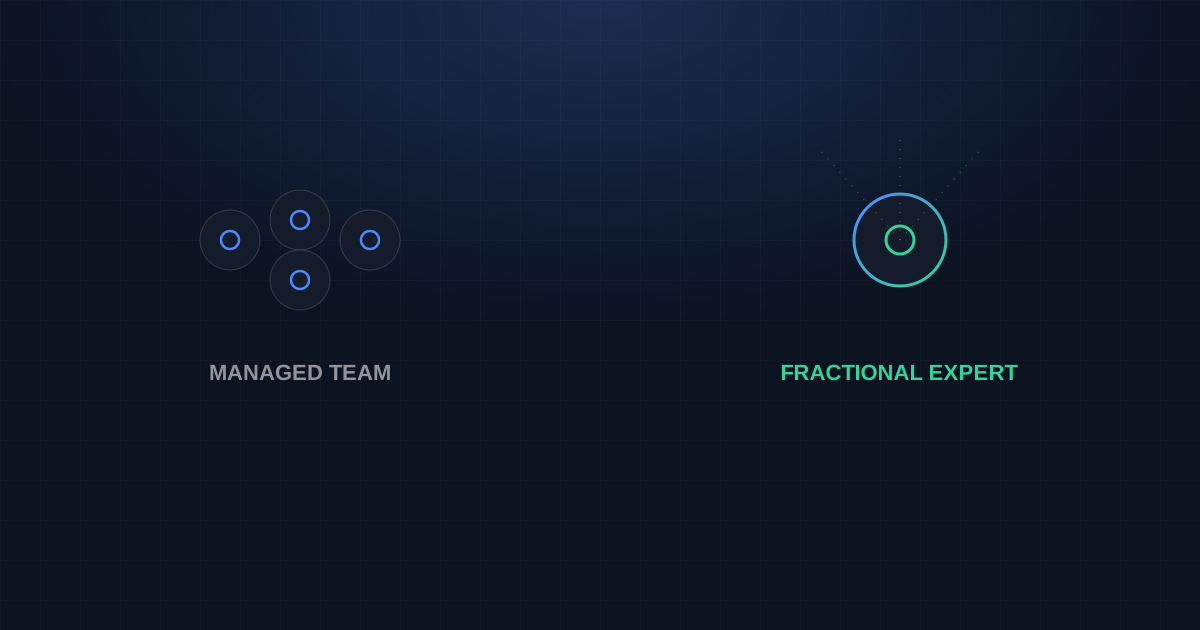
A managed IT provider is essentially an outsourced IT department. You get a team, a help desk, monitoring tools, and a service-level agreement covering response times. It's built for volume: routine tickets, day-to-day support, patch management, and break-fix issues across a growing headcount.
Managed IT makes the most sense when:
- You have enough staff that day-to-day tickets are a real, recurring volume — typically 15+ employees.
- You need guaranteed response times and a help desk your team can call directly.
- Your IT needs are largely operational, keeping things running, rather than strategic.
What a fractional IT consultant actually is
A fractional consultant isn't a help desk, it's senior-level decision-making, available part-time, without the cost of a full-time hire. Instead of a queue of tickets, you get a single accountable person who understands your business and makes, or guides, the calls on architecture, vendors, security posture, and roadmap.
Fractional consulting makes the most sense when:
- You're too small to justify a full-time IT hire, but too complex to run on ad-hoc help alone.
- What you actually need is judgment and direction — "should we migrate now, and to what" — more than ticket volume.
- You want continuity with one person who knows your systems, rather than rotating help desk staff.
The real difference isn't price — it's what problem you're solving
It's tempting to compare these purely on cost, but that misses the point. Managed IT solves a staffing problem: you need hands to keep the lights on at scale. Fractional consulting solves a decision-making problem: you need a senior perspective without paying for a full-time executive.
Many growing businesses actually need both eventually — a managed provider, or in-house staff, handling day-to-day operations, and a fractional advisor setting the direction they operate within. The mismatch happens when a business hires an MSP expecting strategic guidance, or hires a strategic consultant expecting them to also run a help desk.
What each typically costs
Managed IT is usually priced per user or per device per month, scaling with headcount — it's built to scale with volume, so the pricing model matches. Fractional consulting is usually priced hourly or as a monthly retainer, since the value is judgment and availability rather than ticket count. Neither is inherently cheaper than the other; they're priced against different things (headcount vs. access to expertise), which is exactly why comparing them on a single number misses what you're actually buying.
A simple way to decide
Ask which of these sounds more like your actual pain point:
- "We have too many tickets and not enough hands" → managed IT.
- "We keep making IT decisions with no one to sanity-check them" → fractional consulting.
- "We don't have anyone thinking about IT until something breaks" → fractional consulting, likely followed by managed IT once the roadmap is clear.
What this looks like in practice
A common, healthy pattern for a growing small business: bring in a fractional advisor first to assess where things stand, set the roadmap, and make the big early decisions — cloud vs. on-prem, what to consolidate, what to migrate. Once there's a clear system and growing day-to-day volume, a managed provider, or an internal hire, takes over operations, with the fractional advisor staying on to keep the strategy honest as the business grows.
The bottom line
Neither option is "better" in the abstract, they answer different questions. If your problem is volume, hire for volume. If your problem is direction, hire for direction. Most small businesses eventually need both, just not necessarily on the same day.
Want help putting this into practice?
Book a free strategy call and we'll map a clear next step.
Book a Strategy Call